Stop Confusing Budget Planning with Business Planning
By Samuel Roy
The executive team had been meeting for nearly three hours.
The annual planning session was drawing to a close. Around the table sat every member of the senior leadership team, working methodically through next year's budget. New positions had been debated. Technology investments had been challenged. Travel budgets had been reduced. Projects had competed for funding. One initiative had been postponed while another had survived because external funding became available. By noon, the numbers balanced, and the Chief Financial Officer declared the exercise complete.
As people began closing their laptops, the CEO leaned forward.
"Before we finish," she said, "I'd like each of us to answer one question. When we meet here a year from now, what will this organization be able to do that it cannot do today?"
The room fell silent.
Everyone could explain where the money was going. No one could clearly describe how the organization itself would be stronger.
I suspect versions of this conversation take place in organizations every planning season. Leadership teams invest enormous time debating resources, priorities, and funding decisions, yet many leave those discussions without ever answering the most important question: How will this organization become more capable of fulfilling its purpose?
Somewhere along the way, many organizations began confusing budget planning with business planning. The distinction may appear subtle, but it fundamentally changes how an organization evolves.
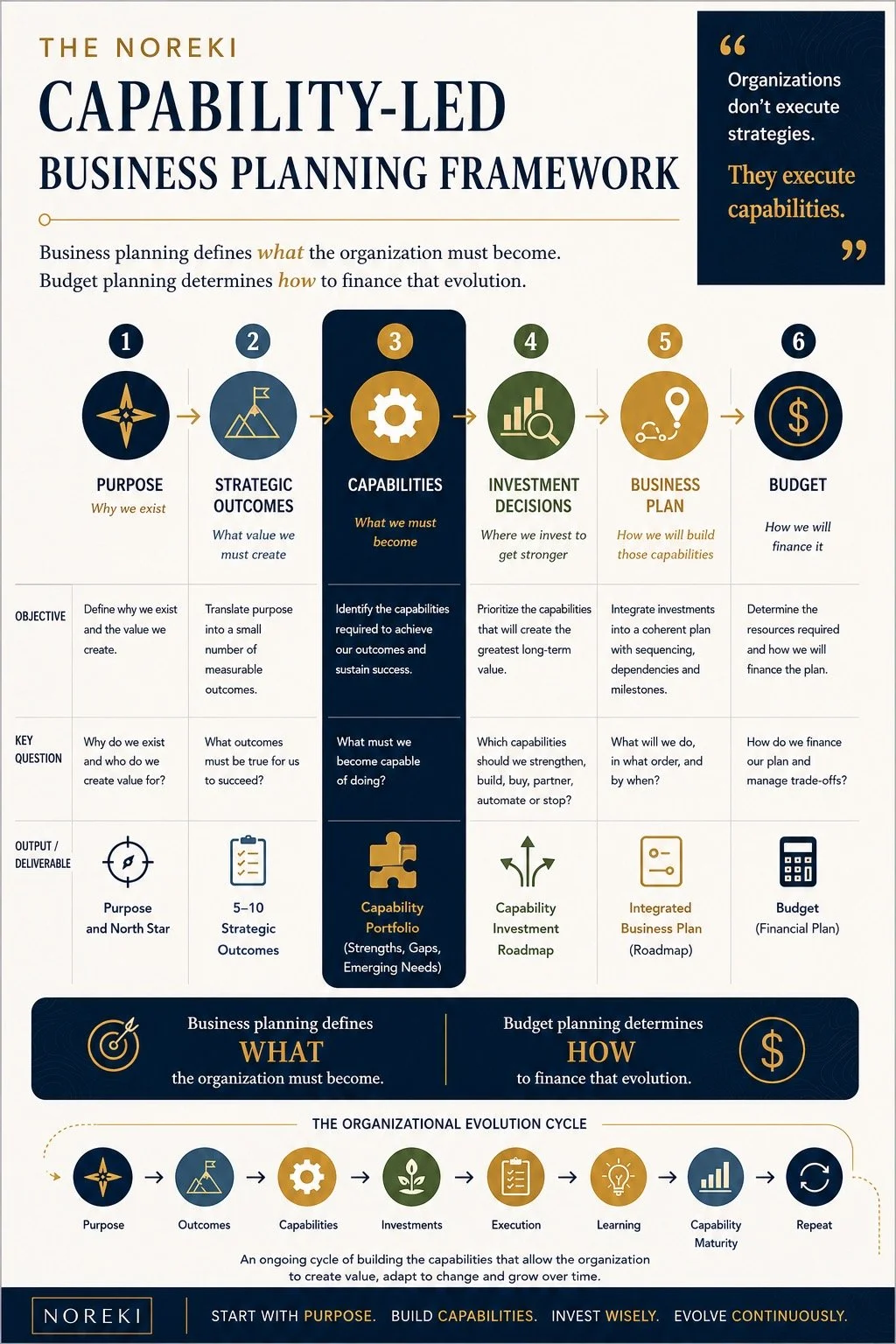
Budget planning is an exercise in allocating resources. Business planning should be an exercise in building the organizational capabilities required to achieve meaningful outcomes. One determines where money will be spent over the next fiscal year. The other determines whether the organization will be better equipped to create value for years to come.
That is a profoundly different objective.
The Missing Link Between Strategy and Results
Most organizations are not short of ambition. Their strategic plans speak about becoming more innovative, more customer-centric, more digital, more resilient, or more collaborative. Those aspirations are usually well conceived. The challenge is not defining where the organization wants to go. The challenge is building the ability to get there.
Too often, there is an implicit assumption that if enough initiatives are funded, the desired transformation will naturally follow. New technology is approved. Additional positions are created. Training programs are launched. Processes are redesigned. Each investment makes sense when viewed independently, and each can be linked to the strategic plan.
Yet strategy is not executed through projects.
It is executed through capabilities.
Projects deliver outputs. Capabilities deliver outcomes. A strategy may define the destination, but capabilities determine whether the organization can consistently reach it.
This distinction is easy to overlook because projects are visible. They have budgets, timelines, milestones, and sponsors. Capabilities are less tangible. They develop gradually, often over years, through deliberate investment and disciplined leadership. They are not something an organization purchases. They are something an organization becomes.
What Is a Capability?
Capability is one of the most frequently used—and least clearly defined—concepts in management. We often use the word to describe expertise, technology, organizational structures, or business processes. While each of these contributes to capability, none of them is a capability in its own right.
An organizational capability is the organization's repeatable ability to consistently produce a desired outcome.
Consider an organization that wants to become genuinely customer-centric.
Its planning process approves a new CRM platform, expands customer service training, hires additional specialists, redesigns the website, and introduces artificial intelligence into service delivery. Every investment is reasonable. Every initiative supports the strategy. Every project is delivered successfully.
A year later, however, customer satisfaction has barely improved.
The explanation is not necessarily poor execution. It may simply be that the organization invested in projects without deliberately building the capability it was seeking.
Customer-centricity does not emerge because technology improved or because employees attended training. It emerges when leadership consistently reinforces customer needs, operational processes support better service, performance measures reward the right behaviours, employees have the skills and authority to solve problems, and technology enables rather than constrains their work. Each investment contributes, but none is sufficient on its own.
The capability is the outcome of those investments working together.
That is why capabilities matter. They represent the organization's enduring ability to create value. Unlike projects, they do not conclude with a closing report. Unlike budgets, they do not expire at the end of the fiscal year. Once developed, they strengthen the organization's ability to execute today while increasing its capacity to adapt, improve, and grow tomorrow.
A Different Purpose for Business Planning
If capabilities are what ultimately determine organizational performance, then perhaps we need to rethink the purpose of business planning itself.
In many organizations, planning has become synonymous with deciding which initiatives deserve funding. The conversation quickly shifts to budgets, business cases, staffing pressures, and competing priorities. Those discussions are important, but they should not come first.
The first conversation should be about the organization itself.
What outcomes are we trying to create?
What capabilities will those outcomes require?
Which capabilities already represent competitive strengths?
Which have become strategic constraints?
Which capabilities must we strengthen if we want this organization to remain effective—not only next year, but five or ten years from now?
Only after answering those questions should leaders begin discussing investments.
Some capabilities may require new technology. Others may depend on leadership development, redesigned operating models, stronger partnerships, better governance, or different ways of working. The specific investments will vary from one organization to another, but they should all serve the same objective: deliberately strengthening the organization's capability to achieve its purpose.
Viewed this way, the budget assumes a very different role.
It is no longer the starting point of business planning.
It becomes the financial expression of the business plan.
Building Organizations That Can Evolve
The organizations that endure are rarely those with the largest budgets. Nor are they necessarily those with the most ambitious strategies. They are the organizations that continually strengthen the capabilities required to execute their strategy, respond to changing conditions, and create value in an increasingly uncertain environment.
Every planning cycle is therefore an opportunity to shape the future of the organization. The question is whether leaders are primarily shaping next year's spending—or next decade's capability.
That, in my view, is the real purpose of business planning.
It is not simply to decide what the organization will do next year. It is to decide what the organization must become.
Once that conversation has taken place, budgeting becomes remarkably clear. Resources are no longer allocated to a collection of disconnected initiatives. They are invested in building the capabilities that will allow the organization to fulfill its purpose, sustain its performance, adapt to change, and continue creating value long after the current budget has been forgotten.
Samuel Roy is the founder of Noreki and the author of The Coherence Gap™: Closing the Distance Between Aspiration and Experience. His work explores how purpose, strategy, leadership, operations, culture, and human energy interact to create organizations where aspiration and experience become increasingly aligned.
