Why Costco Feels Different
By Samuel Roy
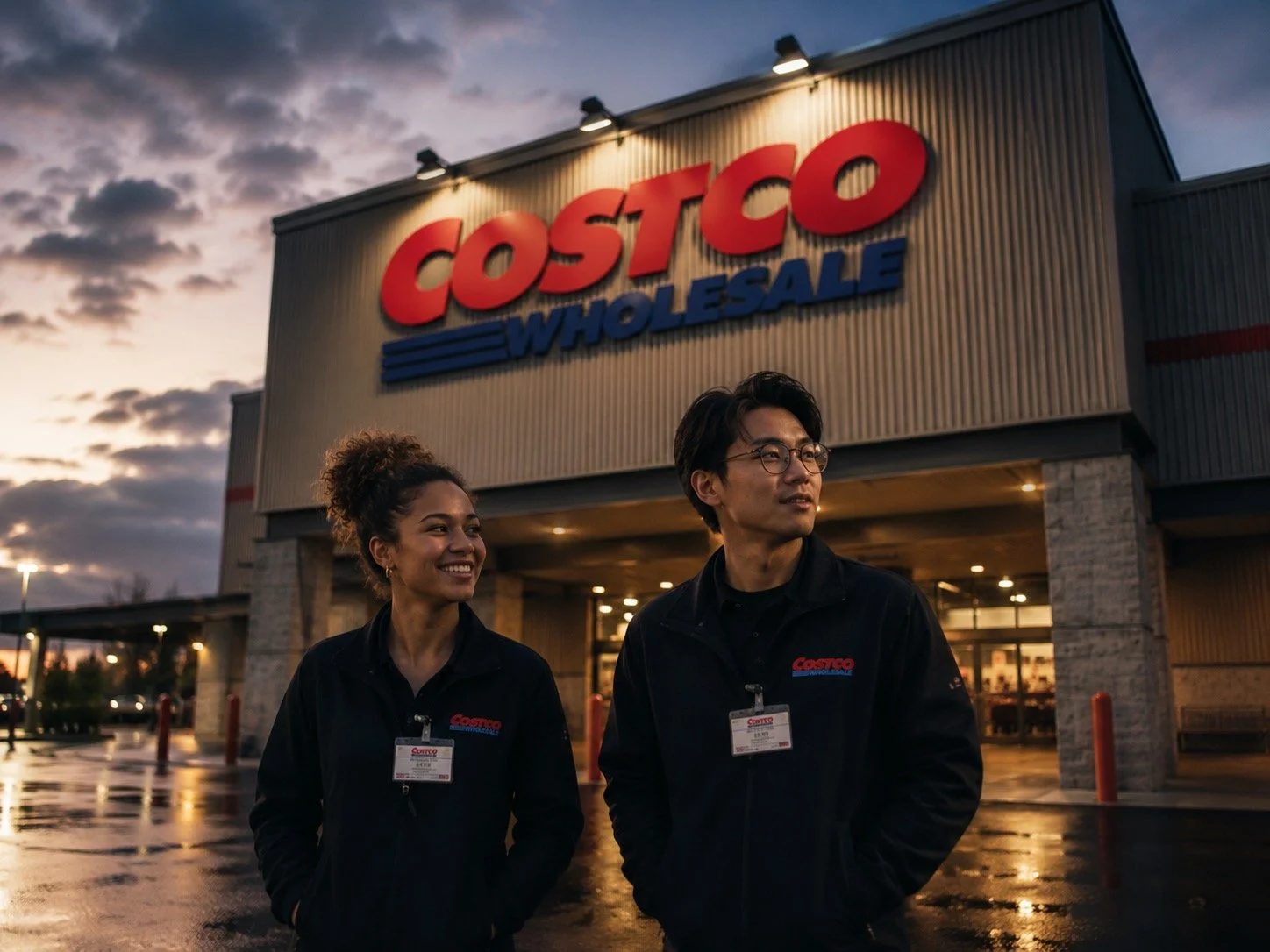
I've walked into a lot of organizations over the years. And after a while, you develop a sense, almost immediately, for whether a place actually believes what it says about its people, or whether the values on the wall are just decoration.
Costco is one of the few large companies I've studied where those two things seem genuinely aligned.
Not perfectly. Not without tension. But aligned in a way that feels structural rather than accidental, built into how the business actually runs, not just how it's described.
That's worth paying attention to.
It's Not Generosity. It's Architecture.
The conversation about Costco usually goes one of two ways. Either people point to the above-average wages and generous benefits as proof that you can be a good company and a profitable one. Or skeptics argue it only works at Costco's scale, in their specific industry, with their specific membership model.
Both conversations miss what's actually interesting.
What makes Costco unusual isn't that it pays people well. It's that the decision to pay people well is connected to almost every other decision the company makes and those decisions all seem to pull in the same direction.
Costco carries fewer products than most retailers. It spends almost nothing on advertising. It accepts margins that would make most CFOs uncomfortable. It charges customers a membership fee just to walk in the door.
None of these decisions look obviously smart in isolation. Together, they reveal something deliberate.
Fewer products means simpler operations and stronger purchasing power. Lower margins build customer trust over time. The membership model creates predictable revenue and turns shoppers into stakeholders. Employee investment reduces turnover, which protects service quality, which reinforces why members keep renewing.
Each decision supports the others. That's not efficiency. That's coherence.
The Cycle Most Organizations Break
Here's what I find most interesting about the Costco model, and most relevant beyond retail.
When employees feel genuinely respected, they tend to stay. When they stay, they develop real knowledge of the work, the customers, the quirks of the operation. That knowledge improves service in ways that are almost impossible to manufacture through training alone. Better service builds loyalty. Loyalty supports financial performance. Financial performance funds continued investment in people.
The cycle becomes self-reinforcing.
It sounds obvious when you write it out. But most organizations quietly break this cycle somewhere, usually under pressure. HR focuses on engagement scores. Finance focuses on headcount costs. Operations focuses on productivity. Customer teams focus on satisfaction metrics. Over time, each function optimizes for its own number, and the system starts pulling in different directions.
Costco appears to have maintained unusual discipline in keeping these forces aligned. Not because it's easy, but because the business model itself seems designed to make misalignment costly.
That's a different kind of organizational design.
The Part Nobody Talks About
Sustaining this is harder than building it.
Costco's philosophy requires resisting pressures that most public companies eventually surrender to; the pressure to cut labor costs when margins tighten, to broaden the product range when growth slows, to optimize for the quarter when investors get restless.
The challenge was never developing the philosophy. Plenty of organizations have philosophies. The challenge is preserving it when the business gets complicated, leadership changes, and the original logic starts to feel abstract.
Coherence isn't a thing you achieve. It's a thing you defend, repeatedly, against a long list of reasonable-sounding arguments for why this specific decision can be an exception.
Most organizations lose that argument more often than they win it.
What This Actually Means for the Rest of Us
I don't think the lesson here is that every organization should operate like Costco. The model is specific to their industry, their scale, their customer base.
The lesson is simpler and harder than that.
When your leadership philosophy, your operational decisions, your employee experience, and your customer value all reinforce each other, rather than quietly competing, something changes. The organization becomes easier to trust. Easier to lead. More resilient when things get hard.
Most organizations pursue culture initiatives, engagement programs, and leadership frameworks while leaving the underlying system unchanged. They encourage collaboration while rewarding competition. They talk about trust while designing processes that signal control. They promote long-term thinking while measuring short-term outcomes.
Those contradictions don't stay invisible forever. People feel them. And over time, they stop believing what the organization says about itself.
Costco is interesting not because it's perfect, but because it's unusually honest, in the way its decisions actually reflect its stated beliefs.
That kind of coherence is rarer than it should be. And in a world where most people have become very good at detecting the gap between what organizations say and what they do, it might be the most underrated advantage a company can have.
Samuel Roy
Exploring Better Ways to Lead, Work, and Grow
Founder, Noreki
