Human Energy: The Next Frontier of Leadership
By Samuel Roy

The executive committee had spent the better part of the morning approving one of the organization's largest investment plans in more than a decade. Every proposal had been supported by rigorous business cases. Financial projections had been challenged, implementation capacity had been reviewed, risks had been assessed and funding had been secured. As the meeting drew to a close, the Chief Financial Officer summarized the discussion with quiet satisfaction.
"It's ambitious," he said. "But we can afford it."
The comment should have ended the conversation. Instead, another executive leaned forward and asked a different question.
"I know we have the money. But do we have the energy?"
The room fell silent.
No one asked for clarification because everyone instinctively understood what she meant. The organization had sophisticated dashboards tracking financial performance, customer satisfaction, operational risk, project delivery and workforce capacity. It could forecast cash flow years into the future and estimate staffing requirements with remarkable precision. Yet no one could confidently answer whether the organization still possessed the collective energy required to deliver everything it had just committed itself to doing.
The question lingered because it revealed something most organizations rarely acknowledge. Nothing fundamental had gone wrong. The organization still employed talented people, pursued a sound strategy and enjoyed healthy financial performance. Customers remained satisfied, turnover was manageable and strategic initiatives were progressing as planned. Yet work felt different. Decisions required more discussion than they once had. Collaboration demanded greater effort. Small obstacles lingered where they would previously have been resolved quickly, and every new initiative seemed to require slightly more effort than the last. The organization had not run out of money, capability or ambition. It had quietly begun running short of something far more difficult to recognize.
The Resource Hidden in Plain Sight
For more than a century, management has become remarkably sophisticated at allocating scarce resources. Organizations invest enormous effort in managing financial capital, technology, facilities, supply chains and talent because leaders understand that long-term performance depends upon using these resources wisely. Entire professions exist to improve the allocation of capital, optimize operations and reduce risk. Yet one resource remains largely invisible despite influencing the effectiveness of every other investment an organization makes.
That resource is not people themselves.
It is the human energy they bring to work every day.
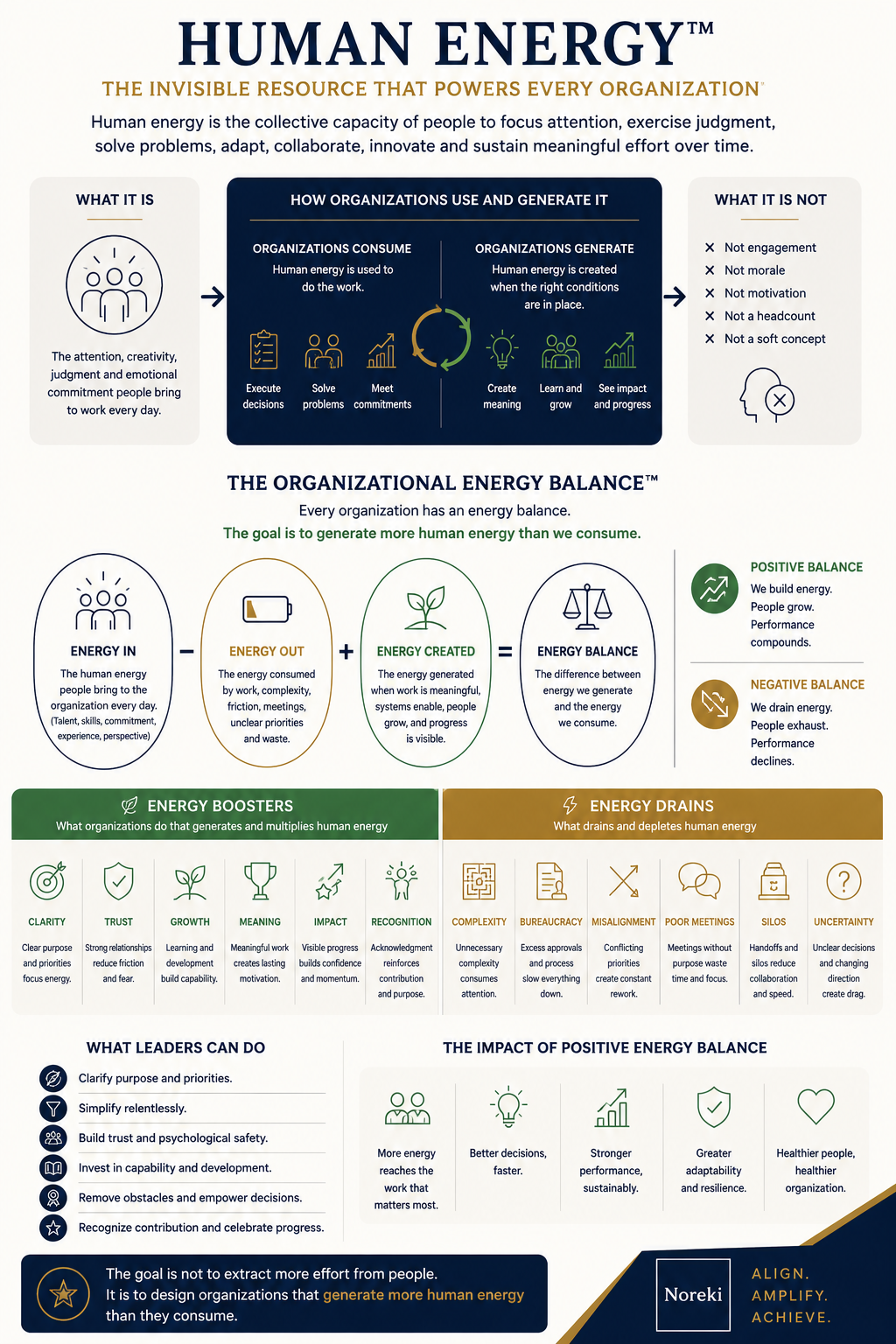
By human energy, I do not mean engagement, morale or motivation. I mean the collective capacity of an organization to focus attention, exercise judgment, solve problems, adapt, collaborate, innovate and sustain meaningful effort over time. It is the resource that transforms capability into execution. Every strategy depends upon it, every transformation consumes it and every customer experience reflects it. Without it, even the most capable workforce cannot convert potential into meaningful results.
Recognizing this distinction changes how we think about organizations. We often describe people as our greatest asset, but organizations do not consume people in the same way they consume financial capital or technology. They consume the attention, creativity, judgment and emotional commitment people bring with them each day. Every meeting requires attention. Every difficult decision demands judgment. Every poorly designed process, conflicting priority or unnecessary approval consumes a little more of that capacity. Unlike financial capital, however, human energy behaves differently. It can certainly be depleted, but it can also be renewed, amplified and multiplied when organizations are designed in ways that allow people to do meaningful work with clarity and confidence.
Organizations Are Energy Systems
This suggests that one of the most enduring metaphors in management has reached its limits. Since the Industrial Revolution, organizations have largely been understood as machines that transform inputs into outputs through increasingly efficient processes. That metaphor revolutionized manufacturing and continues to shape much of modern management thinking. Knowledge-intensive organizations, however, operate according to different principles. Their most important input is no longer raw material or financial capital. It is human energy expressed through judgment, creativity, collaboration and learning.
Every day, organizations receive extraordinary amounts of human energy through the people who work within them. The question is not whether organizations consume that energy—they all do. The more important question is what they do with it. High-performing organizations convert human energy into innovation, customer value, stronger relationships and meaningful progress. Poorly designed organizations dissipate it through unnecessary complexity, bureaucracy and friction. The difference between the two is not the quality of their people. It is the quality of the system through which that energy flows.
Consider two organizations with similar budgets, comparable technology and equally talented people. In the first, priorities are clear, governance enables timely decision-making and leaders continuously remove unnecessary complexity. Teams understand how their work contributes to a larger purpose, trust one another and spend most of their effort creating value rather than navigating internal obstacles. Progress builds confidence. Learning strengthens capability. Trust reduces friction. Employees finish demanding days tired, yet energized by the knowledge that their effort accomplished something meaningful.
The second organization appears remarkably similar on paper. It employs capable people, offers competitive compensation and pursues an equally compelling strategy. Yet priorities have gradually become fragmented, approval processes have multiplied and internal systems have grown increasingly difficult to navigate. Meetings consume more time than decisions. Reporting requirements expand while accountability becomes less clear. Teams invest growing amounts of effort coordinating with one another rather than serving customers or advancing the mission. None of these conditions appears catastrophic in isolation. Together, however, they quietly consume enormous amounts of attention, judgment and emotional capacity. The organization receives the same human energy every morning, but far less of it reaches work that creates value.
From Energy Consumption to Energy Generation
This is where leadership begins to matter in a fundamentally different way.
Organizations do not simply consume human energy.
They also generate it.
Meaningful work generates energy. Learning generates energy. Trust generates energy. Visible progress generates energy. When people experience clarity, autonomy, growth and purpose, they often leave work with greater confidence and capability than when they arrived. Great organizations do not merely extract effort from people; they create the conditions in which human energy compounds.
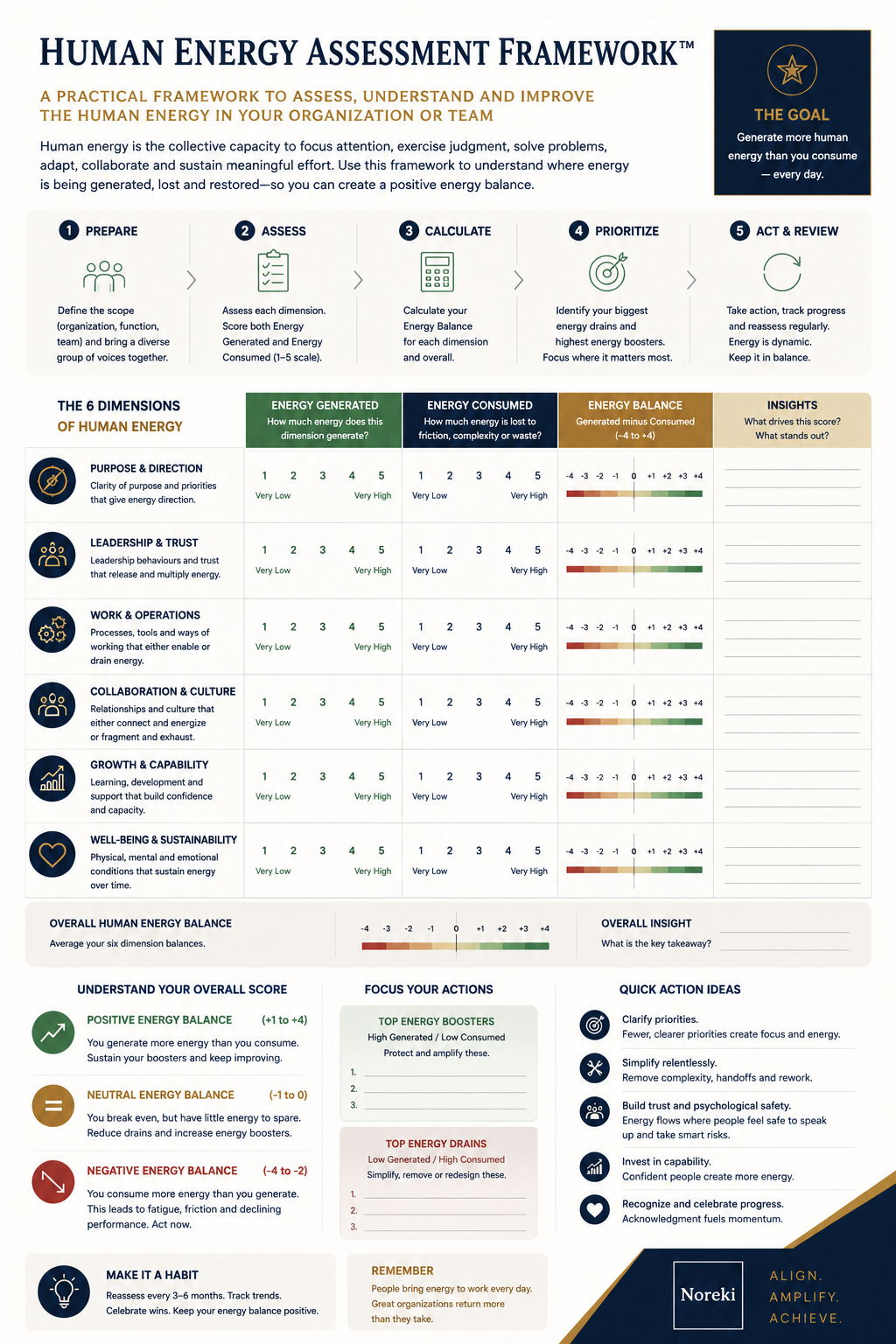
This is why I believe organizations should begin thinking in terms of their OrganizationalEnergy Balance™, the difference between the human energy an organization consumes and the human energy it generates. Organizations with a positive energy balance replenish the capacity they ask people to invest. Organizations with a persistent energy deficit rely increasingly on heroic individual effort to compensate for systemic friction, gradually exhausting the very resource upon which future performance depends. The consequences rarely appear overnight. They emerge slowly through declining innovation, slower decision-making, reduced adaptability and the growing sense that every objective now requires more effort than it should.
If human energy is a strategic resource, leadership teams need to begin asking different questions.
Where is energy being generated across our organization, and where is it being depleted?
Which decisions create Energy Dividends™, and which impose Energy Taxes™?
If we doubled our strategic ambitions tomorrow, would we have the human energy required to execute them?
Are we designing work that leaves people stronger than when they began it?
These questions will not provide precise answers overnight, but they represent a different way of seeing organizations—one that recognizes human energy as something to steward with the same discipline applied to capital, technology and risk.
Why Coherence Matters
This perspective also deepens our understanding of organizational coherence. In previous articles, I described coherence as the alignment of purpose, strategy, leadership, operations, culture and human energy around a common direction. Human energy is often interpreted as one dimension among the others. I have come to believe it is something more fundamental.
It is the force that animates every other dimension.
Human energy is the force that animates every dimension of organizational coherence. Purpose gives it meaning. Strategy gives it focus. Leadership releases its potential. Operations ensure it is not wasted. Culture determines whether it spreads or dissipates. Coherence ensures that as much human energy as possible reaches the work that matters most instead of being dissipated through unnecessary complexity and internal friction. In that sense, coherence is not simply about alignment. It is about reducing organizational energy loss.
The Next Frontier of Leadership
For more than a century, management has pursued an essential objective: producing more with fewer resources. That pursuit transformed industries and remains one of the defining achievements of modern management. The organizations that thrive in the decades ahead, however, may distinguish themselves through a different capability. Rather than asking only how to optimize capital, technology or productivity, they will ask how to become better stewards of the one resource that activates all the others.
Human energy may ultimately prove to be the scarcest resource in the knowledge economy, not because people are less committed than previous generations, but because organizational complexity has quietly become one of its greatest hidden costs. Leaders who recognize this shift will understand that their responsibility extends beyond allocating budgets and defining strategy. Their deeper task is to design organizations that convert human energy into meaningful outcomes with as little waste as possible.
The organizations that succeed will not simply outperform their competitors. They will build the rarest of capabilities: the ability to sustain extraordinary performance because each success strengthens, rather than depletes, the energy on which the future depends.
Perhaps that is the next frontier of leadership.
Not extracting more effort from people.
But designing organizations that generate more human energy than they consume.
Samuel Roy is the founder of Noreki and the author of The Coherence Gap™: Closing the Distance Between Aspiration and Experience. His work explores how purpose, strategy, leadership, operations, culture, and human energy interact to create organizations where aspiration and experience become increasingly aligned.
