Scaling Organization with Coherence
By Samuel Roy
Every executive wants their organization to grow.
Growth is often the clearest sign that an organization is succeeding. More customers, more programs, more employees, more locations and larger budgets all suggest that the organization is creating value. Yet anyone who has led a growing organization knows that somewhere between a small, agile organization and a larger, more established one, something begins to change.
It rarely happens all at once.
The changes are subtle at first. Decisions take longer than they used to. Teams begin solving similar problems in different ways. Managers spend more time coordinating work than advancing it. New employees arrive with enthusiasm but struggle to understand how decisions are really made. Leaders find themselves attending more meetings while feeling less connected to what is happening across the organization.
Nothing appears fundamentally broken. Yet the organization no longer feels like the one that earned its success.
Most leaders instinctively respond by looking for additional resources. They approve new positions, invest in technology, introduce new governance committees or reorganize reporting relationships. These actions are often necessary, but they do not address the underlying challenge. Growth is not simply the accumulation of more people, systems or processes. It is the ability to increase an organization's capability and capacity while preserving the coherence that made it effective in the first place.
The distinction may seem subtle, but it changes the conversation entirely.
Growth Creates Complexity
When organizations are small, coherence emerges almost naturally. People know one another personally. Information flows through informal conversations. Decisions are made quickly because leaders share the same context. Problems are often resolved before they require formal processes because everyone understands why the organization exists and how work gets done.
As organizations grow, those natural advantages begin to disappear. Communication becomes layered. Decision-making becomes distributed. Specialized teams develop their own language, priorities and ways of working. The organization becomes more capable in some respects, yet more difficult to coordinate in others.
Complexity itself is not the problem.
In fact, complexity is an inevitable consequence of growth. The world's most successful organizations are remarkably complex. What distinguishes them is not that they have fewer moving parts, but that those parts continue to reinforce one another. Purpose informs strategy. Strategy shapes priorities. Leadership behaviours support the culture. Operations enable execution. People understand not only what they are doing, but why it matters.
Complexity becomes manageable when coherence grows alongside it.
When coherence does not keep pace, growth begins to generate friction instead of value.
The Wrong Question
One question appears in executive discussions more than almost any other.
"Do we need more people?"
Sometimes the answer is yes. Organizations cannot grow indefinitely without expanding their workforce. Hiring remains one of the most important ways to increase capability and capacity.
The difficulty is that it has become the default answer to almost every scaling challenge.
When projects accumulate, organizations hire. When service standards decline, they hire. When new priorities emerge, they hire. Additional people are often assumed to be synonymous with additional organizational capacity.
Sometimes they are.
Sometimes they are not.
A larger workforce also increases communication requirements, management complexity, onboarding needs, coordination costs and decision-making overhead. Hiring expands capability only when the organization is prepared to integrate that capability effectively.
The better question is not whether we need more people.
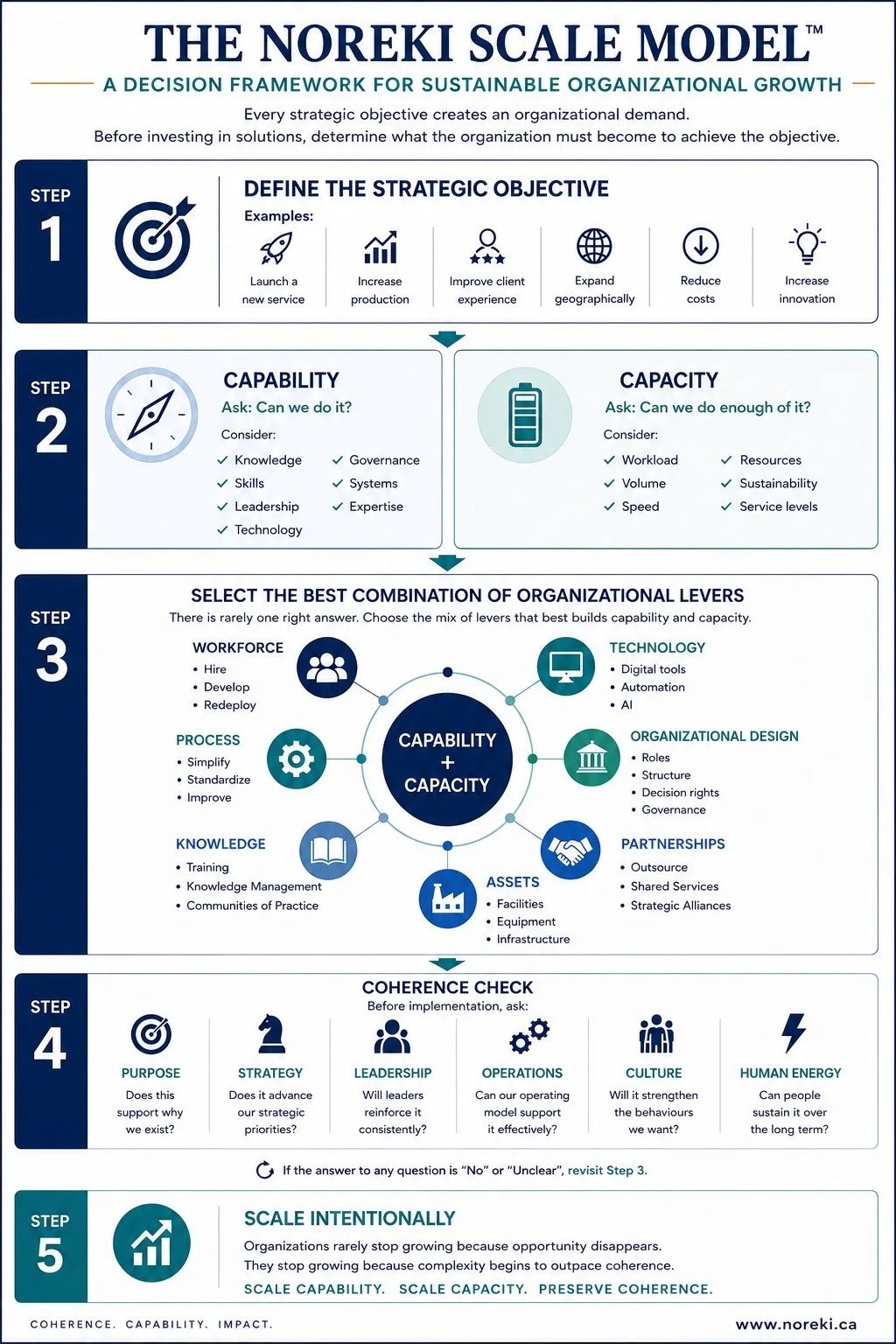
The better question is: What capability are we trying to build, what capacity do we require, and what is the best combination of organizational levers to achieve it?
That question shifts leadership away from resources and toward organizational design.
Organizations Scale Through Many Levers
Capability answers a simple question: Can we do this?
Capacity answers another: Can we do enough of it consistently?
Neither depends exclusively on workforce size.
Organizations build capability and capacity through many different means. They recruit talented people, but they also automate routine work, simplify processes, redesign organizational structures, strengthen leadership, invest in technology, develop internal expertise, establish strategic partnerships and improve the way knowledge is shared across the organization.
Each of these investments changes the organization's ability to deliver results.
The challenge is deciding which combination creates the greatest value.
Consider an organization facing increasing demand for HR services. One executive team may approve additional positions. Another may automate administrative transactions, redesign workflows, introduce an AI assistant for managers, outsource specialized work and strengthen the capability of frontline leaders to resolve routine issues independently. Both organizations have increased capacity, but they have done so in fundamentally different ways.
Neither approach is universally correct.
The most effective leaders understand that scaling is not about choosing a single lever. It is about selecting the combination of levers that best strengthens the organization's overall capability while preserving coherence.
Where Coherence Becomes Essential
This is where many growth strategies quietly fail.
Organizations often invest in individual solutions without considering how those solutions interact.
They introduce new technology without changing processes. They create new leadership roles without clarifying decision rights. They hire specialists without strengthening collaboration across teams. They outsource activities without redefining accountability. Each decision may be reasonable on its own, yet together they create an organization that feels increasingly fragmented.
Scaling is not simply about making individual parts stronger.
It is about ensuring those parts continue to reinforce one another.
This is why organizational coherence becomes increasingly important as organizations grow. Purpose must remain clear enough to guide decisions across a larger workforce. Strategy must provide sufficient focus to prevent resources from being dispersed. Leadership practices must remain consistent enough to create trust across multiple teams. Operations must evolve without becoming unnecessarily complex. Culture must continue to shape behaviour despite geographical distance and organizational layers. Human energy must be sustained so that growth does not come at the expense of engagement and adaptability.
As organizations become larger, coherence shifts from being an organizational advantage to becoming an organizational necessity.
Scaling Is a Design Challenge
As leaders, we spend a great deal of time deciding what our organizations should achieve. Perhaps we should spend just as much time asking what our organizations must become in order to achieve it. Because every strategy creates an organizational demand. And every decision to build capability or increase capacity either strengthens that organization or makes it more complicated.
The organizations that scale successfully understand the difference. They know that growth is measured not only by what they add, but by how well everything continues to work together. In the end, organizations rarely stop growing because opportunity disappears. They stop growing because complexity begins to outpace coherence.
Samuel Roy is the founder of Noreki and the author of The Coherence Gap™: Closing the Distance Between Aspiration and Experience. His work explores how purpose, strategy, leadership, operations, culture, and human energy interact to create organizations where aspiration and experience become increasingly aligned.