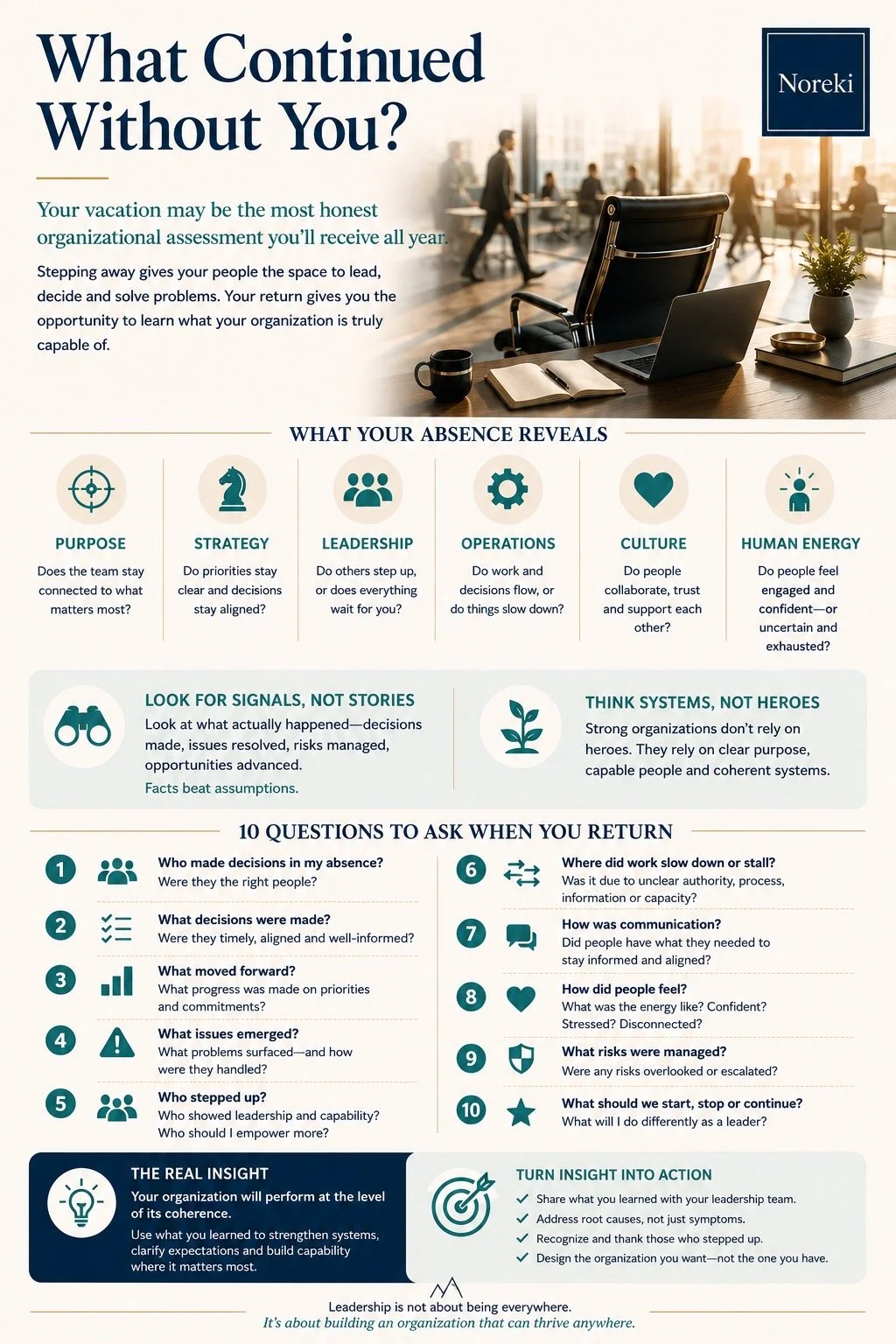
What Continued Without You?
By Samuel Roy

Sometimes the greatest lesson from a vacation isn't what you leave behind. It's what you discover when you return.
A senior executive returned to the office after two weeks away. Like many leaders coming back from vacation, the first hour followed a familiar routine. Coffee in hand, he opened his laptop expecting an overflowing inbox, a calendar packed with meetings, and more than a few urgent requests.
At first, nothing seemed unusual. Several decisions had been left untouched until his return. A meeting had been postponed because "it would be better to wait." One project had lost momentum while another appeared to have stalled altogether. His first reaction was almost instinctive: They really needed me.
Then he kept reading.
Another team had faced a similar challenge during those same two weeks. Rather than waiting, they discussed their options, made a decision within the authority they already had, informed the appropriate people, and kept moving. Their update wasn't asking for approval. It simply explained what they had decided and why.
The contrast stayed with him. Two teams. Similar situations. Completely different responses.
As he reflected on the past two weeks, he realized his vacation hadn't simply created a backlog. It had unintentionally revealed how different parts of the organization actually worked. Some continued moving with confidence. Others quietly stopped, waiting for someone to return.
A Natural Organizational Experiment
That observation has stayed with me because every summer organizations experience one of the few natural experiments they never intentionally design. Leaders disconnect. Subject matter experts take well-earned vacations. Informal conversations become less frequent, and many of the routines that quietly keep work moving begin to disappear.
Most people assume summer naturally slows organizations down. I'm not convinced it does. I think summer temporarily removes some of the supports organizations rely on every day. When those supports disappear, we get a clearer picture of how the organization actually functions. Which decisions are genuinely distributed? Which ones still depend on a particular individual? Where do people confidently exercise judgment, and where do they wait because they have become accustomed to someone else making the call?
Those differences were almost certainly present long before anyone packed a suitcase. Summer simply gave us an opportunity to notice them.
When Dependence Looks Like Leadership
I often see organizations celebrating indispensable people. The manager everyone depends on becomes the expert. The leader who approves every important decision becomes the trusted authority. These individuals are usually talented, dedicated people, and their contributions deserve recognition. Over time, however, organizations can unintentionally confuse individual capability with organizational capability.
The strongest organizations are rarely the ones with the smartest individual leaders. They are the ones where clarity is shared. People understand the purpose behind their work. Priorities remain stable. Decision rights are understood. Teams trust one another to exercise sound judgment without waiting for someone else's return.
At Noreki, I describe this as organizational coherence—the alignment of purpose, strategy, leadership, operations, culture, and human energy so that the organization generates momentum beyond any one individual. When coherence is strong, progress doesn't depend on a single person being present. It comes from a shared understanding of what matters, who decides, and how people work together.
Looking at Your Organization with Fresh Eyes
As you return from vacation this summer, resist the temptation to measure your absence by the number of emails waiting in your inbox. Instead, spend a few days observing your organization with fresh eyes. Which teams continued making good decisions? Which work slowed unnecessarily? Which decisions genuinely required your involvement, and which simply waited because that had become the habit?
Those observations may tell you more about your organization than months of meetings, dashboards, or employee surveys. They won't provide every answer, but they will often point you toward the questions that matter most.
Within a few days, your inbox will be under control. The backlog will fade. Business will return to normal.
Before it does, pause for a moment and ask yourself one question.
What continued without you?
Samuel Roy is the founder of Noreki and the author of The Coherence Gap™: Closing the Distance Between Aspiration and Experience. His work explores how purpose, strategy, leadership, operations, culture, and human energy interact to create organizations where aspiration and experience become increasingly aligned.