The Expedition That Lost Its Mission but Not Its Way
By Samuel Roy
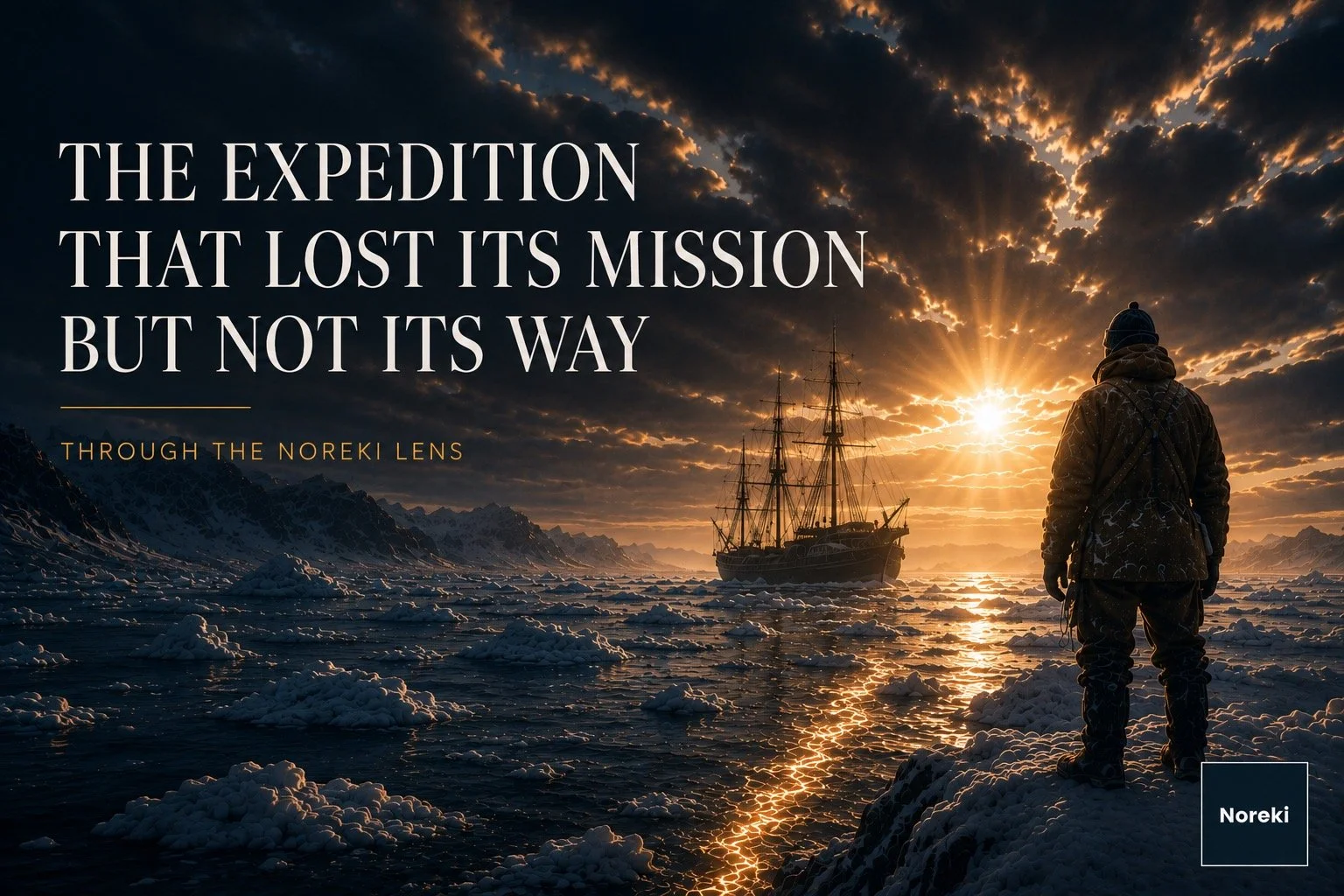
What Ernest Shackleton Teaches Us About Coherence
Some of history's greatest leadership lessons come from failed expeditions.
At first glance, that seems impossible. We tend to measure leadership by whether a mission succeeds. Did the strategy work? Was the objective achieved? Did the organization reach its destination?
Ernest Shackleton's story challenges that assumption.
In 1914, he set out to accomplish one of the last great feats of exploration: crossing Antarctica on foot. Before the journey could truly begin, his ship, Endurance, became trapped in pack ice, drifted helplessly for months, and was eventually crushed beneath the frozen sea. The expedition never completed its mission. By almost any conventional measure, it was a failure.
Yet more than a century later, Shackleton is still regarded as one of history's greatest leaders. The reason has little to do with exploration. It has everything to do with what happened after the original plan became impossible.
The expedition lost its mission.
It never lost its way.
When the Plan No Longer Fits Reality
Organizations devote enormous effort to developing strategy, but far less attention to what happens when strategy no longer reflects reality. Markets shift, technologies emerge, governments change direction, budgets disappear, and unexpected events rewrite carefully crafted plans.
The organizations that struggle most are not necessarily those with the weakest strategy. They are often the ones that lose coherence.
Leaders begin solving different problems. Teams interpret priorities differently. Processes continue serving yesterday's objectives while new expectations quietly emerge. Everyone remains busy, committed, and well-intentioned, yet the organization gradually stops moving in the same direction. Performance usually declines later. Coherence disappears first.
Shackleton recognized this almost immediately. Once Endurance became trapped, crossing Antarctica was no longer a realistic objective. Rather than spending precious time defending the original plan, he accepted a difficult truth: the mission had changed.
From that moment forward, every decision was guided by a single objective—bringing every member of the expedition home alive.
More Than Good Leadership
That decision did more than redefine success. It quietly realigned the entire expedition.
The purpose became unmistakably clear. Because the purpose changed, the strategy changed with it. Exploration gave way to survival, patience, and adaptation. Leadership also changed. Shackleton remained visible, calm, and decisive without pretending to control circumstances he could not control. His role was no longer to lead an expedition across Antarctica; it was to help people navigate uncertainty together.
The same alignment appeared in everyday operations. Meals continued at regular times. Responsibilities remained clear. Equipment was carefully managed. Daily routines persisted even when progress had stopped completely. These were not administrative details. They created stability in an environment where almost nothing else could be predicted.
The expedition's culture reflected the same discipline. Rank became less important than contribution. Humour was encouraged. Optimism was protected. People looked after one another because survival depended on collective effort rather than individual achievement.
Perhaps most remarkably, Shackleton understood that his most valuable resource was neither food nor equipment. It was human energy. Physical supplies could be rationed, but hope, resilience, and morale required constant attention. He understood something many organizations still overlook: people can endure extraordinary uncertainty, but they struggle to endure inconsistency, confusion, and the feeling that their efforts no longer matter.
Looking back, it becomes clear that Shackleton was doing more than making good leadership decisions. He was preserving alignment across every part of the expedition. Purpose reinforced strategy. Strategy shaped leadership. Leadership influenced operations. Operations strengthened culture. Culture protected human energy. Each decision made the next one easier because each decision reinforced the same objective.
That is coherence.
Coherence Survives Strategy
Modern organizations often respond to disruption by producing more plans, more governance, and more communication. Those responses are sometimes necessary, but they rarely solve the underlying problem if people no longer share a common direction.
Shackleton responded differently. Before worrying about the next plan, he restored coherence.
That may explain why the expedition continued functioning under conditions that should have torn it apart.
It also suggests a broader principle:
Strategy will eventually change. Coherence cannot.
Every organization eventually reaches a moment when its original assumptions no longer fit reality. A competitor reshapes the market. Funding is reduced. Technology evolves faster than expected. Customer expectations shift. The organizations that navigate those moments most successfully are rarely those with perfect plans. They are the ones capable of preserving coherence while discovering a new strategy.
Why His Story Still Matters
It is tempting to see Shackleton's expedition as an extraordinary story from another era. Most of us will never lead people across Antarctic ice.
Yet every executive eventually encounters a different kind of frozen landscape. Priorities change unexpectedly. Plans become obsolete. Certainty disappears. The real challenge is no longer deciding where to go. It is helping people continue moving together while the destination is being redefined.
Perhaps that is why Shackleton's story continues to resonate more than a century later. He never completed the mission that brought him to Antarctica, but he preserved something even more valuable. He preserved the alignment between purpose, strategy, leadership, operations, culture, and human energy long enough for every member of his expedition to return home.
Every organization will eventually lose its plan.
The best ones never lose their way.
Samuel Roy is the founder of Noreki and the author of The Coherence Gap™: Closing the Distance Between Aspiration and Experience. His work explores how purpose, strategy, leadership, operations, culture, and human energy interact to create organizations where aspiration and experience become increasingly aligned.





















Psychological safety is often discussed in theory, but its clearest test may be surprisingly simple: where do employees go when they make a mistake? This article explores how leaders build trust, accountability, and psychological safety through the way they respond when things go wrong.