The Arthur Principle: What King Arthur Taught Me About the Future of Leadership
By Samuel Roy
A few nights ago, I was watching King Arthur. Like many people, I knew the story well enough that I wasn't paying much attention to the battles or even to Excalibur. It was the final scene that captured my attention.
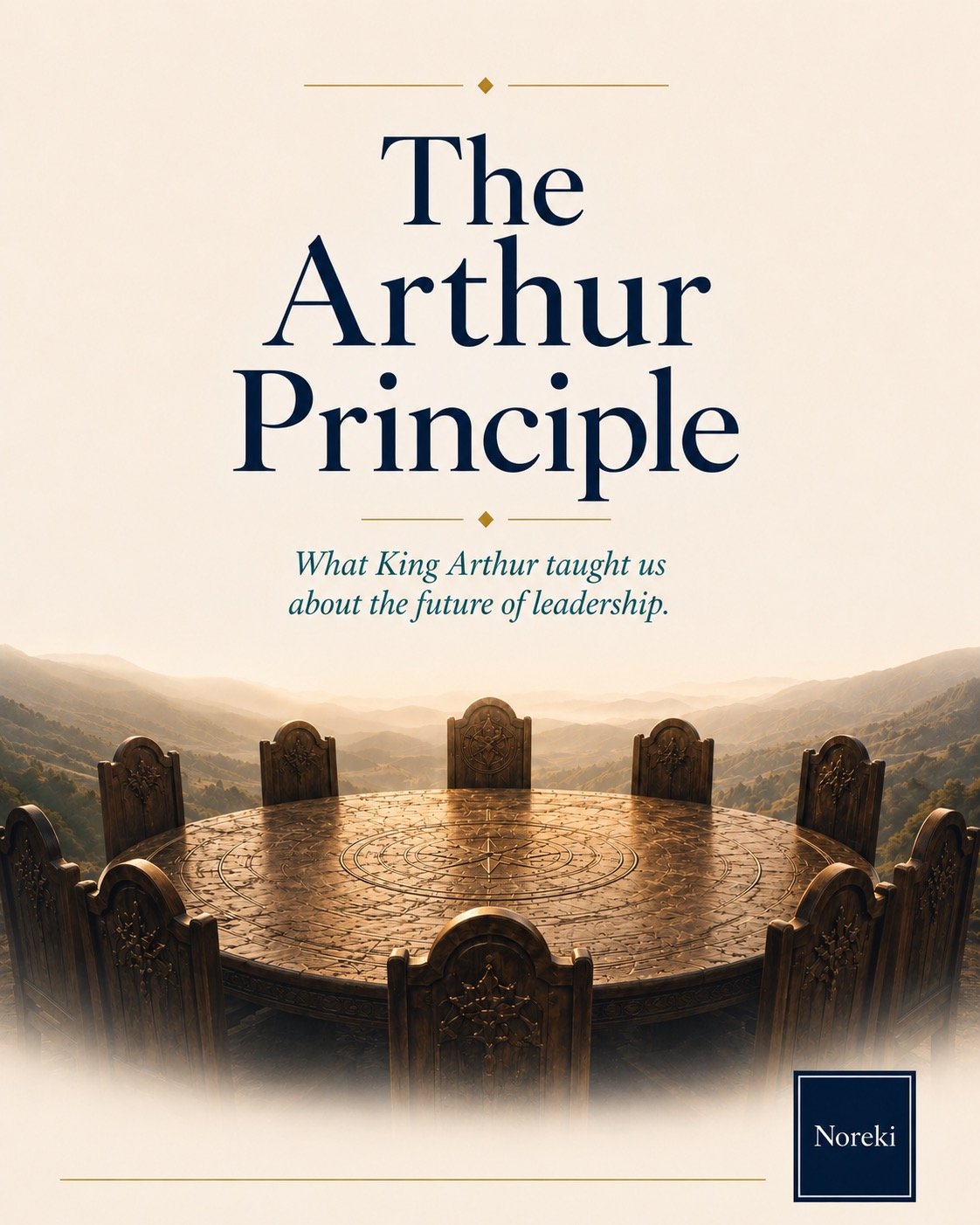
Arthur begins building the Round Table.
As the credits rolled, I found myself thinking less about medieval legend and more about modern organizations.
Why a round table?
The symbolism seems obvious. No seat sits above another. Every knight can see every other knight. Every voice has an opportunity to shape the discussion. Yet one detail suddenly struck me.
Arthur was still the king.
The Round Table did not eliminate hierarchy. It redefined the relationship between authority and wisdom. Arthur remained accountable for the kingdom, but he refused to believe that wisdom should flow only from the throne.
The more I reflected on that scene, the more I wondered whether we are wrestling with the same question today.
For years, leadership thinkers have debated whether organizations should become flatter, more agile, and less hierarchical. Entire management philosophies have been built around decentralizing decisions, empowering teams, and pushing authority closer to where the work happens. Much of this thinking has merit because traditional hierarchies often slow learning, suppress expertise, and create unnecessary bureaucracy.
Yet the debate has always felt incomplete to me because it assumes hierarchy itself is the problem.
Perhaps it isn't.
Perhaps hierarchy is simply being asked to perform functions that no longer belong to it.
Hierarchy Isn't the Problem
For most of history, hierarchy was humanity's most effective coordination technology. It solved three fundamental challenges: moving information, coordinating large groups of people, and making decisions. When communication was slow and information scarce, concentrating authority was not only logical—it was necessary. Information travelled upward, decisions travelled downward, and hierarchy held the system together.
Technology has fundamentally changed that reality.
Today, information moves instantly across organizations. Expertise is distributed throughout the workforce rather than concentrated at the top. Teams collaborate across functions, geographies, and time zones with ease. Artificial intelligence can synthesize knowledge from thousands of sources in seconds.
Organizations no longer need hierarchy to move information.
They still need it to create accountability.
That distinction changes how we should think about organizational design.
Many organizations continue to rely on hierarchy for problems that networks now solve far better. Valuable knowledge is filtered through multiple layers before reaching decision-makers. Front-line insights lose context as they travel upward. Decisions become slower not because leaders lack capability, but because the organization itself delays the flow of intelligence.
At the same time, another movement has emerged. Some organizations have concluded that hierarchy itself should disappear. They flatten structures, distribute decision-making broadly, and celebrate self-management as the solution to bureaucracy. These approaches often increase innovation and engagement, but they reveal another reality.
Networks generate intelligence.
They do not automatically generate accountability.
When priorities compete, resources become constrained, or difficult trade-offs must be made, someone must still make the decision and accept responsibility for its consequences. Accountability cannot be crowdsourced.
The Arthur Principle
This is why I believe the future belongs neither to traditional hierarchies nor to completely flat organizations. It belongs to organizations that intentionally combine the strengths of both.
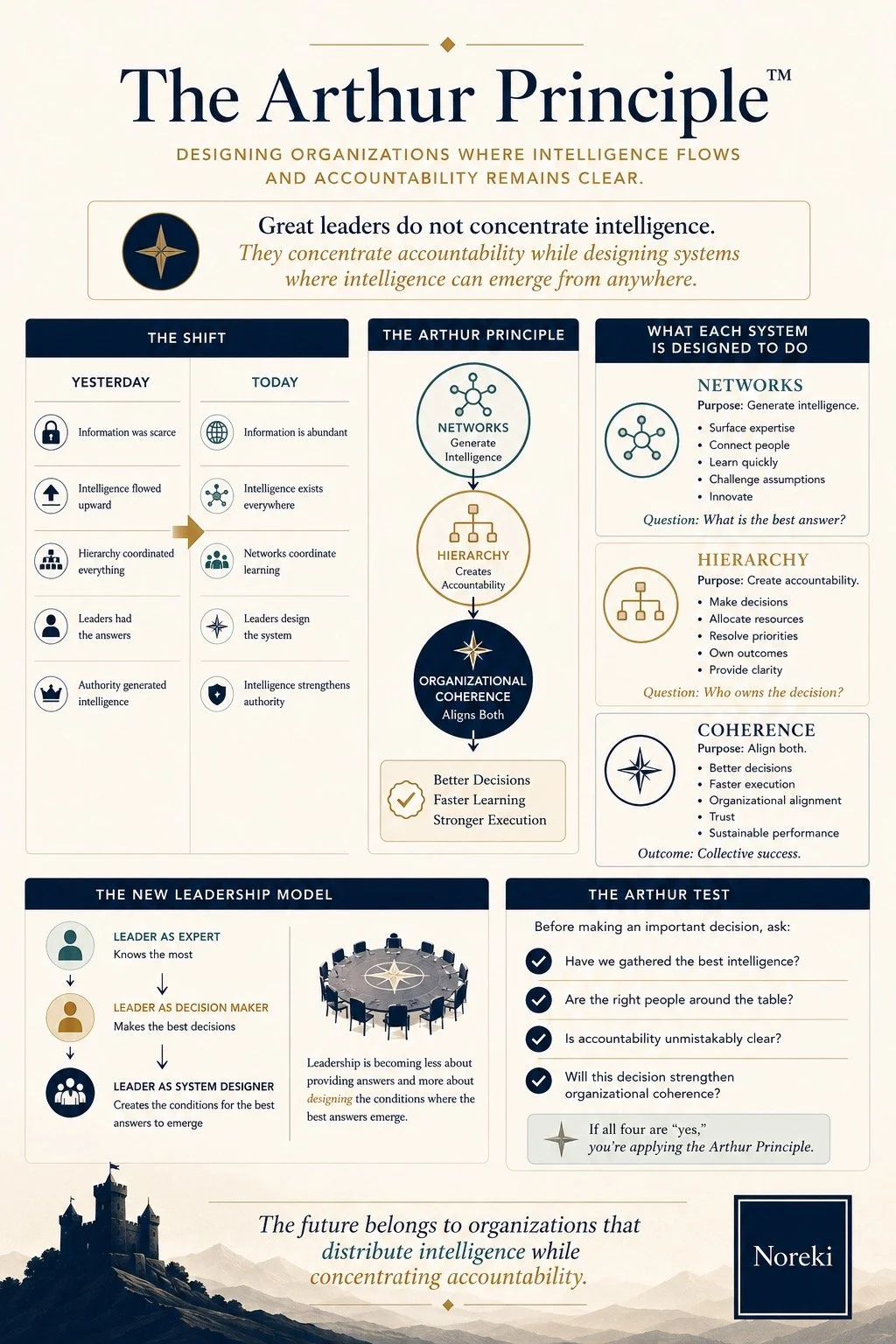
Networks are exceptional at generating intelligence. They connect expertise, surface diverse perspectives, accelerate learning, and improve the quality of options available to decision-makers.
Hierarchy serves a different purpose. At its best, it provides clarity about who owns decisions, allocates resources, resolves competing priorities, and remains accountable for organizational outcomes.
These are not competing philosophies.
They are complementary organizational technologies.
Seen through this lens, Arthur's Round Table becomes far more than a symbol of equality.
The knights were not invited because they possessed equal authority. They were invited because each brought knowledge, judgment, and experience that strengthened the kingdom's decisions. Arthur understood that leadership was not about concentrating intelligence at the top of the organization. It was about designing a system where the best intelligence could emerge before decisions were made.
His authority was strengthened, not diminished, by creating that system.
That is the Arthur Principle.
Leadership is not about concentrating intelligence. It is about concentrating accountability while distributing intelligence.
Leadership as a Design Discipline
For generations, leaders were expected to know more than everyone else because they had access to more information than everyone else. That assumption is becoming increasingly unrealistic. The complexity of modern organizations exceeds the knowledge any single individual can possess.
The leader's role is therefore changing.
Leadership is becoming less about providing the best answers and more about creating the conditions for the best answers to emerge. The most effective leaders are no longer the primary source of organizational intelligence; they are the architects of systems that allow collective intelligence to flourish without sacrificing clarity of accountability.
This is where organizational coherence becomes critical.
Coherence does not emerge because everyone agrees, nor because every decision is made collaboratively. It emerges when people understand a shared purpose, contribute their expertise, and align behind decisions that are both well informed and clearly owned.
In coherent organizations, intelligence is widely distributed while accountability remains unmistakably clear. The role of leadership is not to choose between hierarchy and networks, but to intentionally design both so they reinforce one another.
Leadership, in other words, is becoming a design discipline.
Building Organizations Worth Gathering Around
As I watched Arthur place the final pieces of the Round Table together, I realized the legend may have endured for reasons that have little to do with medieval history.
The table wasn't round because leadership disappeared.
It was round because wisdom no longer depended on where you sat.
Perhaps that is the challenge facing every modern organization.
Not to dismantle hierarchy.
Not to romanticize flat organizations.
But to redesign leadership around a simple principle: allow intelligence to flow wherever it exists while ensuring accountability remains unmistakably clear.
For centuries, organizations were designed as pyramids because information had to move upward before decisions could move downward. Today, information moves in every direction. The challenge is no longer to redesign the flow of information. It is to redesign the flow of leadership.
Arthur's greatest innovation was never the Round Table itself. It was recognizing that the strength of a kingdom would depend less on the wisdom of its king than on his ability to bring together the wisdom of the kingdom.
That may be the leadership challenge of our own time.
Great leaders are not remembered because they sat above the table.
They are remembered because they built one worth gathering around.
Samuel Roy is the founder of Noreki and the author of The Coherence Gap™: Closing the Distance Between Aspiration and Experience. His work explores how purpose, strategy, leadership, operations, culture, and human energy interact to create organizations where aspiration and experience become increasingly aligned.

























Psychological safety is often discussed in theory, but its clearest test may be surprisingly simple: where do employees go when they make a mistake? This article explores how leaders build trust, accountability, and psychological safety through the way they respond when things go wrong.